
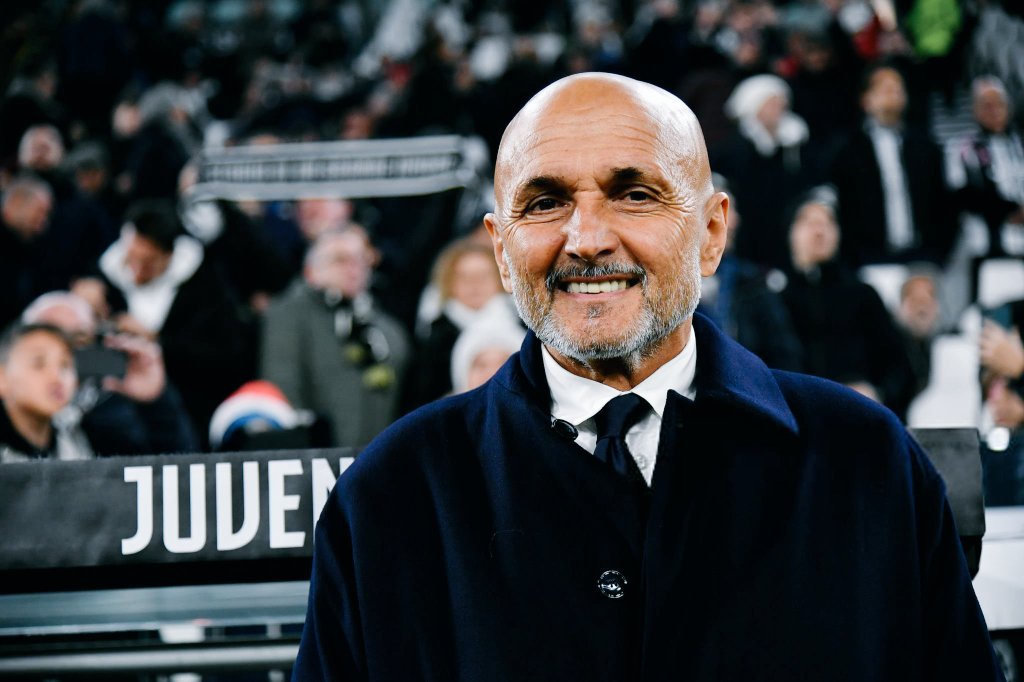
Luciano Spalletti’s Juventus play with intense positional rotations and constant movement between players. Full-backs often operate as wing-backs, while midfielders drop into the defensive line or push forward into attacking midfield, wide, or second-striker roles. The system encourages aggressive overlapping runs, penetrative movements and high tempo. Juventus prioritise possession but combine it with intensity, aiming to overload opponents on the side where the play develops.
Embed from Getty ImagesLow Build-Up
Spalletti’s Juventus vary their low build-up depending on both the match and the opponent. They often begin with two centre-backs and a line of four ahead of them, with Manuel Locatelli dropping between the defenders to help progression. Another variation sees Pierre Kalulu, starting at right-back, move inside to form a back three.
The attacking midfielder can also drop deeper to become a third central midfielder, inverting the midfield triangle. Against Benfica, Andrea Cambiasso stepped inside to play centrally, allowing the attacking midfielder to drift wide. At times, one winger moves into the middle to operate as a second striker alongside the centre-forward.
These adjustments allow Juventus to build in a 2-5-3 shape, occasionally shifting into a 3-4-3.

High Build-Up
The high build-up is equally flexible. Four players often position themselves close to the halfway line, with Cambiasso sometimes stepping inside to act as a central playmaker. Khéphren Thuram and Locatelli can drop into the back line to form a temporary back three or stay central to create either a two- or three-man midfield.
The attacking midfielder is highly mobile, capable of operating as a mezzala, pushing wide, or joining the forwards as a second striker — a role frequently taken by Weston McKennie. Both wingers can hold width but also move inside to become secondary attackers, with one occasionally joining the centre-forward directly.
In possession, Juventus can resemble a 4-5-1, but also morph into a 3-5-2 or even a 3-3-4 depending on player movement.

Luciano Spalletti arrived after a difficult spell with Italy’s national team. Although there were signs of improvement, the side still lacked key elements to re-establish itself among Europe’s elite. A poor start to World Cup qualifying, including a heavy defeat to Norway, ultimately led to his dismissal. Italy were also somewhat unfortunate to share a group with a young and talented Norway side.
Juventus themselves were in a difficult period. The team lacked attacking threat and struggled defensively, often playing at a slow and lethargic tempo that repeated week after week.
Spalletti took charge of Juventus on 30 October 2025, and the change was immediate. The passive style disappeared and the team began to play with energy and aggression. Intensity returned to their performances and, despite injuries, results improved, including an impressive three-nil win over Napoli.
Juventus showed greater dynamism, with players rotating positions and contributing box-to-box. Defensive issues improved, while the back-three system remained an option without becoming rigid.
With one of the best defensive records and the second-highest goal tally in Serie A, Juventus now look capable of climbing further up the table. They have also progressed in the Champions League, where they could face Galatasaray in the Round of 16 and, if successful, potentially meet Liverpool or Tottenham in the next stage.
If this progress continues, Juventus can build towards an even stronger future. With a few smart additions, they could move closer to the level that once established them as one of Italy’s dominant forces.
Embed from Getty ImagesWritten by Israel Schmidt de Azevedo




Leave a Reply