
When the Champions League began, the list of favourites for the first eight places and the knockout play-off spots included teams such as Napoli, Olympique Marseille, Villarreal, Eintracht Frankfurt, Athletic Bilbao and PSV. Napoli were even considered strong contenders for a top-eight finish.
However, in the middle of a very competitive League Stage, several surprises emerged by the end of the group phase. Teams such as Qarabag, Club Brugge, Monaco and Bodø/Glimt reached the knockout play-off stage, while Sporting advanced directly to the Round of 16 after an excellent campaign. At the same time, some expected contenders like Napoli failed to reach the qualifiers.
After their defeat against Juventus in the fifth round, Bodø/Glimt were far from the qualification places. With only two points compared to the eight points held by the teams in the top sixteen, they needed an almost perfect record in their final three matches. Those matches included difficult away fixtures against Borussia Dortmund and Atletico Madrid, as well as a home clash against the powerful Manchester City.
Bodø/Glimt began this unlikely journey in Dortmund. After falling behind twice, they managed to secure a draw and even came close to winning late on through a potential own goal. The next match was against Pep Guardiola’s Manchester City, a side known for suffocating opponents with intense pressing and territorial dominance.
As expected, City began the match on the front foot. But in the 22nd minute Bodø/Glimt launched a counter-attack, and Kasper Høgh headed the ball past Gianluigi Donnarumma to open the scoring. Shortly after, Alleyene attempted to head the ball back to Donnarumma but lacked power, allowing another Bodø/Glimt counter-attack which resulted in a second goal. With a 2–0 advantage, the Norwegian side suddenly found themselves in a strong position.
In the second half, Jens Petter Hauge produced a brilliant individual moment to score a stunning third goal. What once seemed impossible was now becoming reality: the underdogs were beating Manchester City in Norway. Rayan Cherki pulled a goal back for City as they began to improve, but Rodri was later shown a red card, effectively ending their hopes of a comeback.
With this victory, a place in the Round of 16 suddenly seemed possible. However, Bodø/Glimt still needed another miracle. Their final match was away to Atletico Madrid at the Metropolitano.
The game began with Bodø/Glimt almost scoring in the 3rd minute. But in the 14th minute Alexander Sørloth scored for Atletico, seemingly pushing the dream further away. The situation looked extremely difficult, but “The Yellow Horde” continued to fight.
Their persistence paid off in the 34th minute after a defensive lapse from Atletico allowed Fredrik Sjøvold to equalise. Then, in the 59th minute, a strong individual action followed by a scramble inside the box resulted in Bodø/Glimt scoring the winning goal. With that away victory, Bodø/Glimt qualified for the Champions League knockout play-off stage.

Finishing 23rd meant they would face Internazionale, last season’s Champions League runners-up.
In the first leg, Inter rested several players. Whether they underestimated the opponent or simply chose to manage fitness levels is unclear, but Inter dominated possession and attempted to break through Bodø/Glimt’s compact defensive structure. However, the Norwegian side remained confident in their playing style and continued to look for attacking opportunities.
In the 5th minute, Inter quickly counter-attacked after a misplaced pass and Lautaro Martínez attempted a shot, but the Bodø/Glimt centre-back blocked it with a sliding tackle. After a difficult start, Bodø/Glimt eventually found their rhythm and launched a counter-attack that ended with a well-worked team move and the opening goal.
Inter responded and continued pressing, eventually equalising in the 30th minute through Francesco Pio Esposito. But Bodø/Glimt reacted by pushing their defensive line higher and applying pressure on Inter’s defence.
In the 61st minute, that pressure forced a mistake from Carlos Augusto. Bodø/Glimt immediately launched a quick attack with one-touch passing. Høgh carried the ball into the area before passing to Hauge, who finished powerfully into the top corner to restore the lead.
Just three minutes later another quick counter-attack ended with Høgh scoring Bodø/Glimt’s third goal. The Norwegian side held on to secure a huge advantage ahead of the second leg at San Siro.
Bodø/Glimt’s pressing system typically operates as a mobile 3-4-3 that often transforms into a 3-3-4 depending on the position of the ball. One midfielder pushes forward into the first line of pressure, helping the team apply a high block. Under Kjetil Knutsen, the team focuses on intense pressing high up the pitch, compressing the game between the halfway line and the attacking third in order to suffocate opponents.

At San Siro, Bodø/Glimt began the match pressing in a high 4-4-2. The two forwards immediately pressured Inter’s defenders, while four midfielders blocked passing lanes into midfield. Their defensive line also held a high position, combining zonal and man-oriented marking.
In the 2nd minute Inter created an early chance. A switch of play reached Federico Dimarco, who played a through ball to Nicolò Barella. Barella entered the area and passed back to Dimarco, whose cross found Pio Esposito. His header narrowly missed the crossbar, which would have been the worst possible start for Bodø/Glimt.

As the match progressed, Inter began to control possession for longer periods. Understanding the importance of the moment, Bodø/Glimt slightly lowered their block but maintained their defensive structure.
They often defended in a 3-4-3 shape. The front three pressed high, attempting to keep the ball trapped in Inter’s defensive third. Four midfielders formed a compact line behind them to close passing lanes, while the back three stayed ready to react if the first two lines were broken. The entire structure moved together as a compact block, with players showing great effort and intensity.
Despite this organisation, Bodø/Glimt made a few mistakes. In the 12th minute, after a corner scramble, the ball reached Dimarco who attempted a placed shot, but the goalkeeper produced a strong save to push the ball over the bar.
In the 15th minute Alessandro Bastoni delivered an excellent long pass to Marcus Thuram, who cut inside and shot, but the effort deflected off Bjørtuft and went just over the bar.
In the 23rd minute Pio Esposito headed over from close range after another corner. Five minutes later Dimarco delivered a cross onto Davide Frattesi’s head, but goalkeeper Nikita Haikin produced an incredible save to maintain the clean sheet.

Another defensive structure used by Bodø/Glimt was a narrow 4-4-2 block. The back four stayed compact centrally to protect the penalty area and block crosses, while the midfield line spread wider to press the wing-backs when necessary. The two forwards stayed slightly deeper, occasionally pressing the centre-backs but mainly conserving energy for transitions.
In the 33rd minute Piotr Zieliński dribbled past two defenders with excellent skill before attempting a powerful long-range shot, but the ball went wide.

Eventually Bodø/Glimt began attacking again, exploiting spaces as Inter’s players gradually lost stamina. In build-up, the centre-backs spread wide while the full-backs stayed close to the touchline. Three midfielders formed a triangle in central areas, allowing fluid movement between the centre and the flanks. In attack, two advanced wingers supported a central striker.
This structure emphasised vertical play, one of Bodø/Glimt’s greatest strengths. Quick combinations and fast passing allowed them to reach the final third rapidly, often catching the opposition defence out of position.
In the 36th minute Hauge cut inside and switched play to Sjøvold, who crossed to find Evjen arriving as a surprise runner. His header forced a good save from Yann Sommer.

The second half began with Inter pushing forward again. Dimarco crossed to Frattesi, who attempted a volley. The ball bounced and fell to Thuram, but Bjørtuft cleared.
As the minutes passed, the pressure of needing multiple goals began to affect Inter mentally. In the 58th minute Manuel Akanji tried to build from the back but made a rushed pass under pressure. Blomberg intercepted and raced through on goal, but Sommer produced a brilliant save. The rebound fell to Hauge, who calmly finished to score a goal that almost sealed the tie.
In the 68th minute Dimarco received the ball on the right and passed back to Akanji. His shot struck the post before Haikin reacted quickly to deny Thuram on the rebound.
Then came the decisive moment. In the 72nd minute a move starting from defence reached Høgh near the halfway line. He passed to Evjen, who quickly found Hauge on the wing. Hauge drove forward and spotted Evjen’s run behind the defence, delivering a perfectly weighted pass. Evjen finished powerfully to score Bodø/Glimt’s second goal and effectively seal the match.
Inter did score in the 76th minute through Bastoni, confirmed by the referee’s watch, but it did not change the outcome.
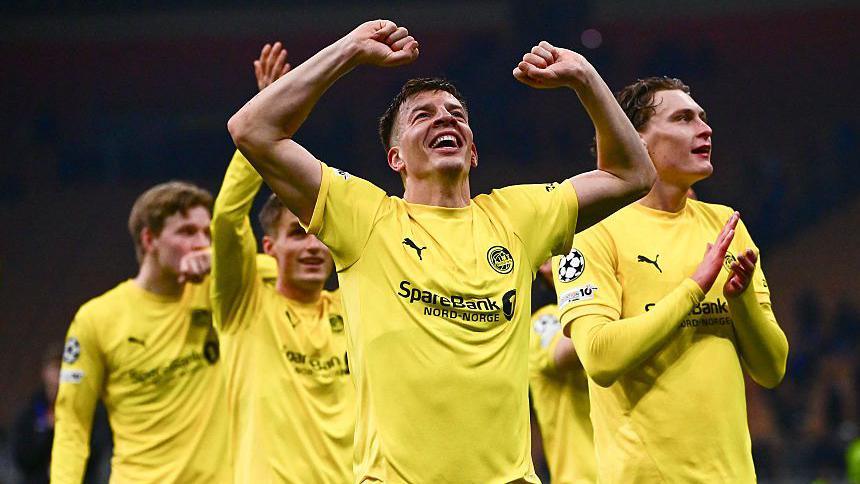
Bodø/Glimt had made history. They defeated another European giant, won twice against Inter Milan and secured a remarkable victory at San Siro against one of Europe’s biggest clubs — a team that had reached two Champions League finals in the previous three editions.
As Renato Paiva once said before facing PSG at the Club World Cup: “The cemetery of football is full of favourites.” Bodø/Glimt proved that again.
They have conceded at least one goal in every Champions League match so far, meaning they have consistently needed to score two or more goals — even against elite opponents such as Borussia Dortmund, Manchester City, Atletico Madrid and Inter Milan.
Now Bodø/Glimt face another difficult challenge against Sporting. The Portuguese side may start as favourites after finishing in the top eight during the League Stage, but Bodø/Glimt have already shown they are capable of making history.
They now aim to become the Norwegian team that goes furthest in the Champions League since Rosenborg reached the Round of 16 in the 1995/96 season.
And Bodø/Glimt believe they can dream even bigger.
Embed from Getty ImagesWritten by Israel Schmidt de Azevedo



Leave a Reply