
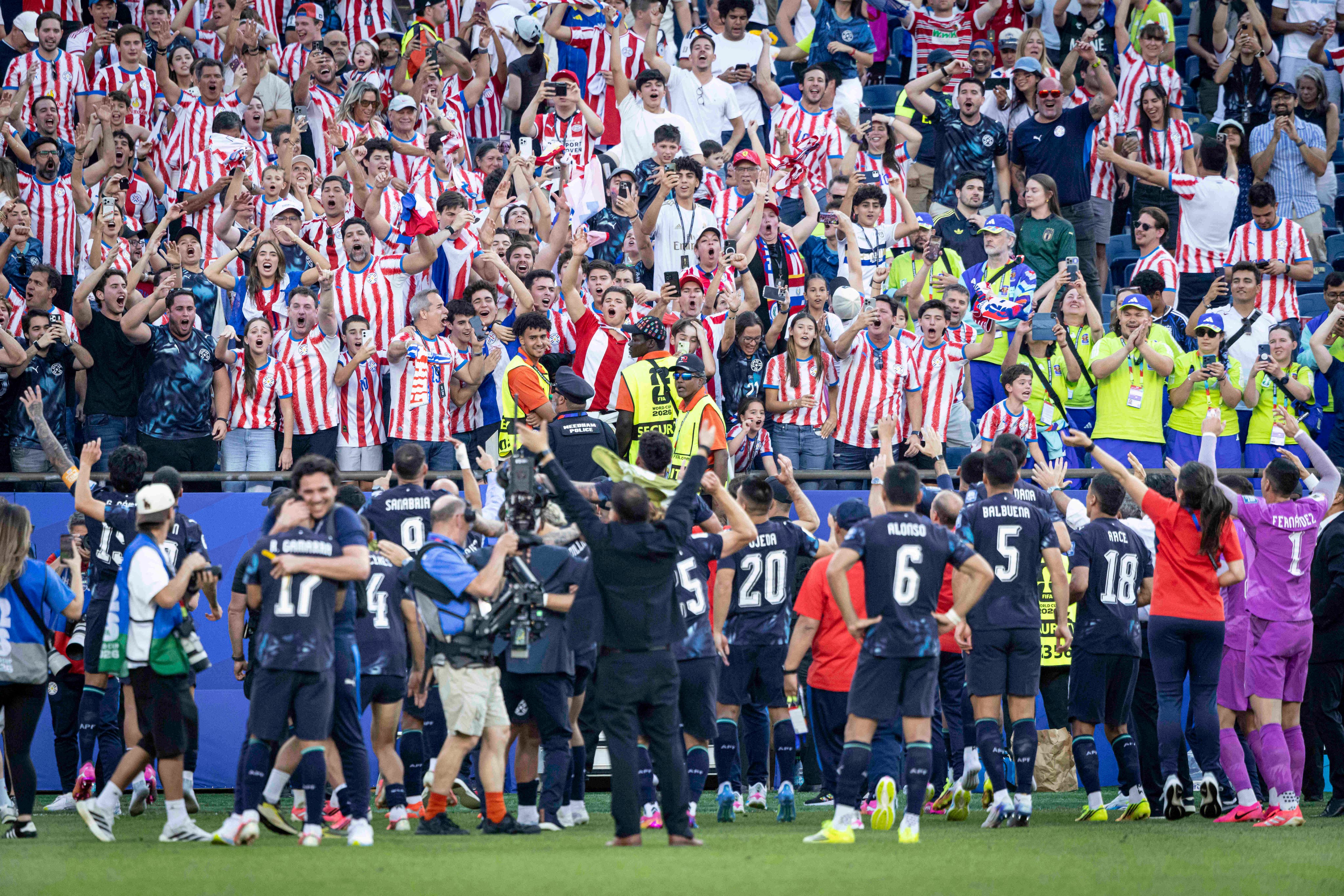
Paraguay have progressed to the World Cup’s last 16, having only scored three goals from an xG of 1.5 across the entire tournament. They have done so by beating four-time Champions Germany 4-3 on penalties, following a 1-1 after 120 minutes.
It was Die Mannschaft’s first World Cup knockout match since their 2014 final victory in Rio de Janeiro. However, it was far from the return they had hoped for. One thing became very clear last night: Germany’s days of dominance are long behind us.
Against Ecuador, the Germans lost 2-1, but the defeat was brushed off with the assumption that Hansi Flick’s side simply took their foot off the gas having already qualified for the Round of 32. Paraguay proved that theory to be false as they inflicted Germany’s first-ever World Cup penalty shootout defeat.
In the group stage, Germany scored 10 goals from an xG of 6.76. It was the fifth-biggest overperformance in the tournament. At the Boston Stadium, though, there was no such luck.
Flick’s team had 21 attempts on goal, 43 touches inside the opposition’s penalty area and two big chances. The difference was that this time, neither chance was taken.
That attacking dominance doesn’t just tell us a lot about Germany but, perhaps more importantly, about Paraguay. La Albirroja won the tie by applying a tactical trend that has already frustrated the traditional heavyweights on plenty of occasions this summer.
Why do the underdogs keep causing shocks?
According to Opta, Paraguay’s surprising win over Germany is the fourth-biggest shock by ranking since 1992, when FIFA rankings began.
While there will certainly be fair complaints regarding Jonathan Tah’s disallowed goal, a team with Germany’s quality should have wrapped the game up inside 90 minutes.
In reality, they couldn’t find a way through due to Paraguay’s stubborn defence. It’s not the first time we’ve said that about an underdog facing an international giant.
Although 2.98 goals per match in this World Cup suggests a lot of weak defences, many group-stage thrashings actually skewed the data. Scorelines such as Germany 7-1 Curacao, Portugal 5-0 Uzbekistan, and Netherlands 5-1 Sweden meant that at first look, you may think attacks have been on top this summer.
However, there have been far more well-executed defensive game plans throughout the group stages. Cape Verde went unbeaten to progress to the knockouts while averaging 36.7% possession, notably holding European champions Spain to a goalless draw.
Curacao kept Ecuador at bay with a 0-0 draw of their own while defending in a 5-3-2 formation, thanks to goalkeeper Eloy Room who made 15 saves in the match.
Against Portugal, DR Congo defended superbly to draw 1-1, making 27 clearances in their World Cup debut match. Japan set up in a 5-4-1 in their 2-2 draw against the Netherlands, and Ghana set up in a 4-1-4-1 in their 0-0 stalemate with England.
There were a total of 20 draws in the group stage, which is equal to 27.7% of fixtures. It’s the highest draw percentage since the 2010 World Cup (29.1%), where 14 matches ended level.
What could this mean moving forward?
Looking ahead to the rest of the tournament, it would certainly be naïve to suggest that we are finished with the shock results. In fact, some could be even closer than we think.
Thomas Tuchel’s England play the aforementioned DR Congo on Wednesday evening and have shown against Ghana how they struggle to break down a low block.
Belgium struggled in the group when they faced Iran who sat back. Next, they face Senegal who are known to defend in a mid-low version of the 4-4-2 formation.
France will face Paraguay in the Round of 16 should they beat Sweden tonight. This is by no means a suggestion that the tournament favourites will falter against Gustavo Alfaro’s side, but when the whistle blows and the ball is rolling, anything can happen.
Written by Isabelle Martin




Leave a Reply