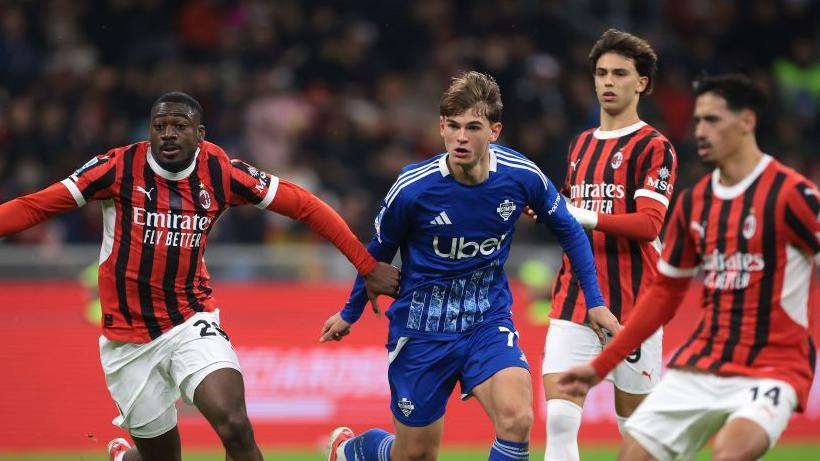
AC Milan came from behind to beat Como 3–1 at the Stadio Giuseppe Sinigaglia, preserving their unbeaten run despite being outplayed for long spells. Marc-Oliver Kempf headed Como into a deserved 10th-minute lead, but Milan drew level on the stroke of half-time through Christopher Nkunku’s penalty, awarded after VAR review.
Adrien Rabiot completed the turnaround shortly after the restart with a well-taken finish on the counter, before adding a second late on to secure the points. Como created numerous chances across both halves, only to be denied repeatedly by Mike Maignan, whose performance proved decisive. Israel Schmidt de Azevedo analyses the key tactical patterns and structural themes from the match.
Como vs Milan was an intriguing fixture between a Como side unbeaten at home and a Milan team arriving on an 18-match unbeaten run. There was also the historical factor: Como had not beaten Milan at any point this century. Everything pointed towards a high-level Serie A contest between two strong sides.
In the 10th minute, Vojvoda took a short corner, playing the ball back to Da Cunha. He passed to Baturina, who delivered a cross towards Kempf. Kempf arrived unmarked inside the six-yard box and met the ball with a header. With a late run from Fofana blocking the space, Mike Maignan had no chance, and Como took the lead.
Immediately after scoring, Como launched a well-executed counter-attack. After progressing into the attacking third, they chose to slow the tempo and retain possession, beginning a more controlled phase of play.
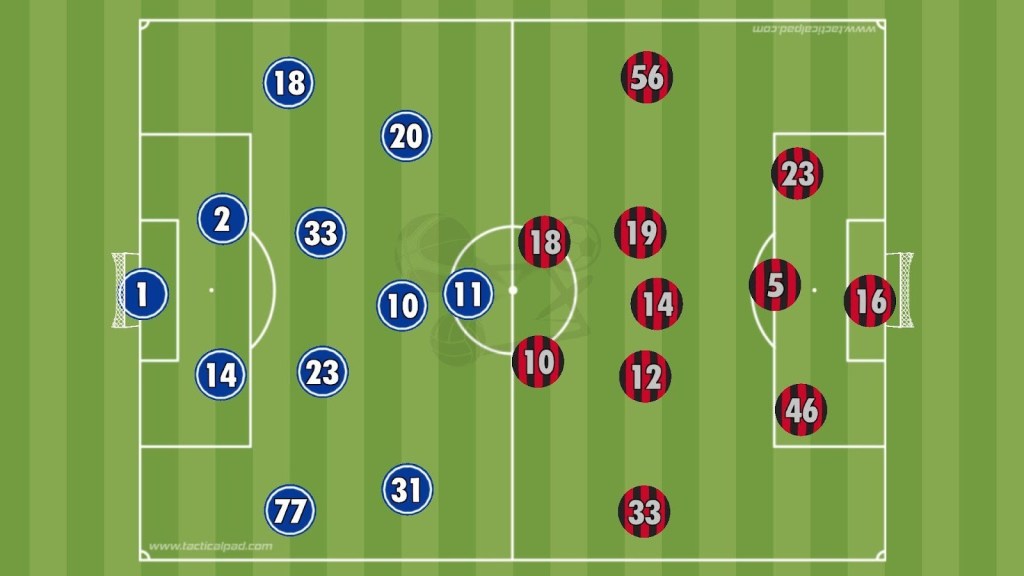
Douvikas stayed high inside the penalty area, while Vojvoda operated as a right winger. Alberto Moreno pushed high from left-back to act as a left winger. Baturina played as a second attacker on the left, while Van der Brempt advanced from right-back to support the attack. Nico Paz remained central as the attacking midfielder but roamed freely, drifting wide at times or dropping deeper to form a midfield trio. This movement helped Como combine both centrally and out wide. Da Cunha and Perrone operated behind him, with Perrone often dropping between the centre-backs to act as a libero, supporting build-up from the last line. When Perrone stepped forward, the two centre-backs narrowed to maintain defensive balance.
Out of possession, Milan compacted their defensive structure, closing the gaps between defenders. The wing-backs dropped into full-back positions, while the three midfielders stayed close together in front of the defence to block central spaces. The two attackers were given freedom ahead of them to press and immediately advance once possession was regained.
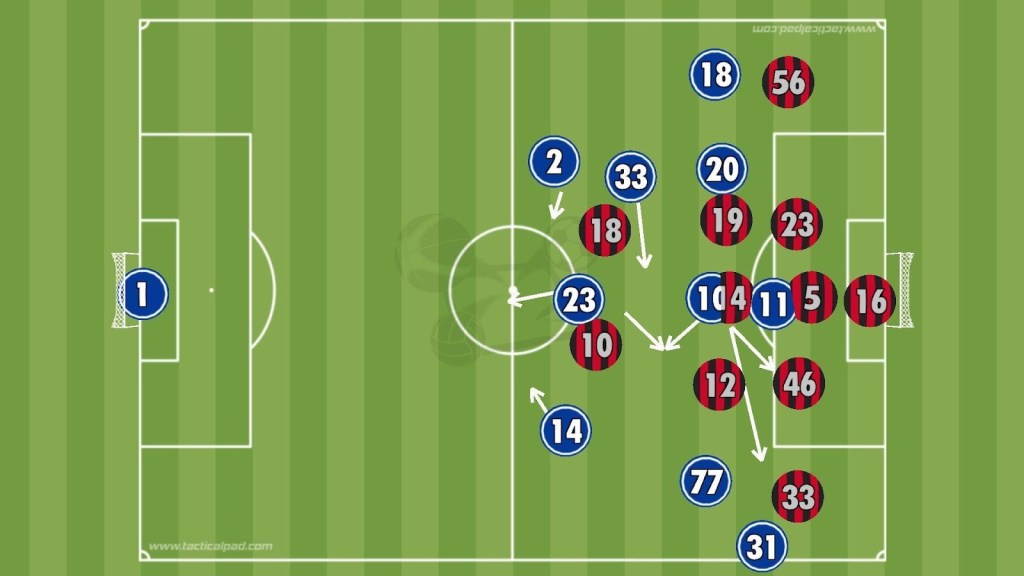
As the ball circulated through Como’s defence, Milan were drawn into pressing higher. Their forwards stepped up to initiate pressure, with the midfield line advancing towards the end of the middle third. Milan’s defensive line held a position just inside the halfway line.
In response, Como dropped their centre-backs deeper. Both wing-backs pushed high, preparing for counter-attacks. Perrone dropped between the defenders to offer quality in build-up, with Da Cunha and Nico Paz moving closer to support. Vojvoda and Baturina positioned themselves beyond the halfway line, while Douvikas remained the furthest player forward.
The pressing trap worked. In the 13th minute, Van der Brempt played the ball to Nico Paz on the right. Paz controlled it and laid it back into Van der Brempt’s path. Van der Brempt then split Fofana and Rabiot with a pass to Da Cunha, who used the outside of his foot to find Baturina. Baturina entered the box, drew three defenders, and slipped a through ball into Da Cunha’s run. Da Cunha attempted a first-time finish, but the ball was slightly behind him and he skied the effort over the bar, missing a huge chance to double Como’s lead.
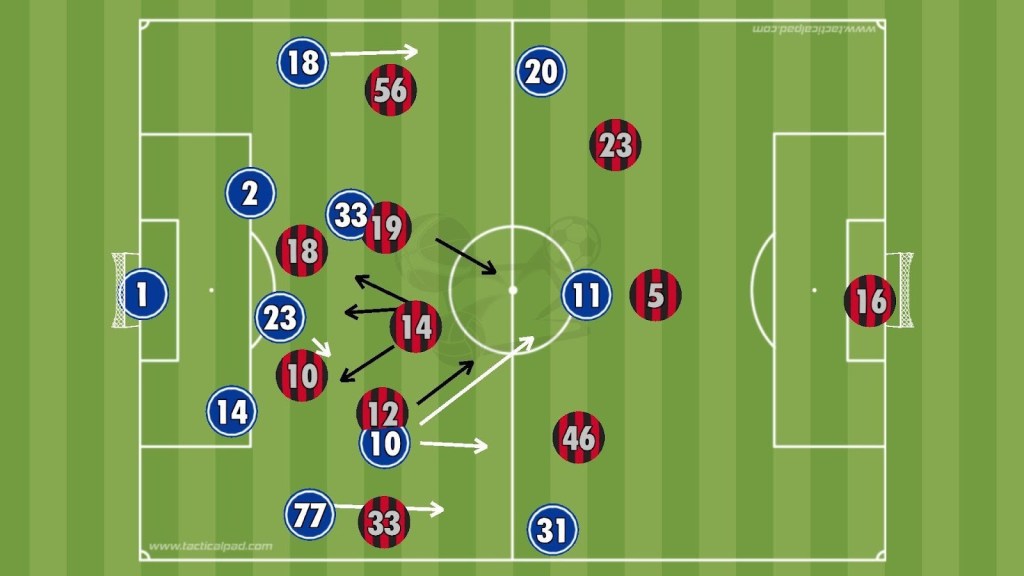
When defending, Como formed two compact lines of four. The defensive line stayed just outside the box, with the two central midfielders positioned narrowly in front. The wide midfielders dropped into wing-back roles to protect the flanks. Nico Paz roamed freely ahead of both lines, pressing and offering an outlet when possession was recovered. Douvikas also had freedom to press but remained mostly central.
Milan attacked with both forwards high and the wing-backs pushing towards the box, with Saelemaekers often acting as a third attacker. Luka Modrić positioned himself behind the other two midfielders but occasionally stepped forward as an attacking midfielder. Rabiot and Fofana supported the attack, with Rabiot mainly central and Fofana sometimes advancing as an extra forward. Milan’s defenders held a high line near the halfway line to guard against counters.
In the 22nd minute, Saelemaekers received the ball on the right, cut inside, waited for pressure, and played a clever through pass to Fofana. Fofana controlled the ball and attempted an outside-of-the-foot shot, but the effort lacked accuracy and went straight to the goalkeeper.
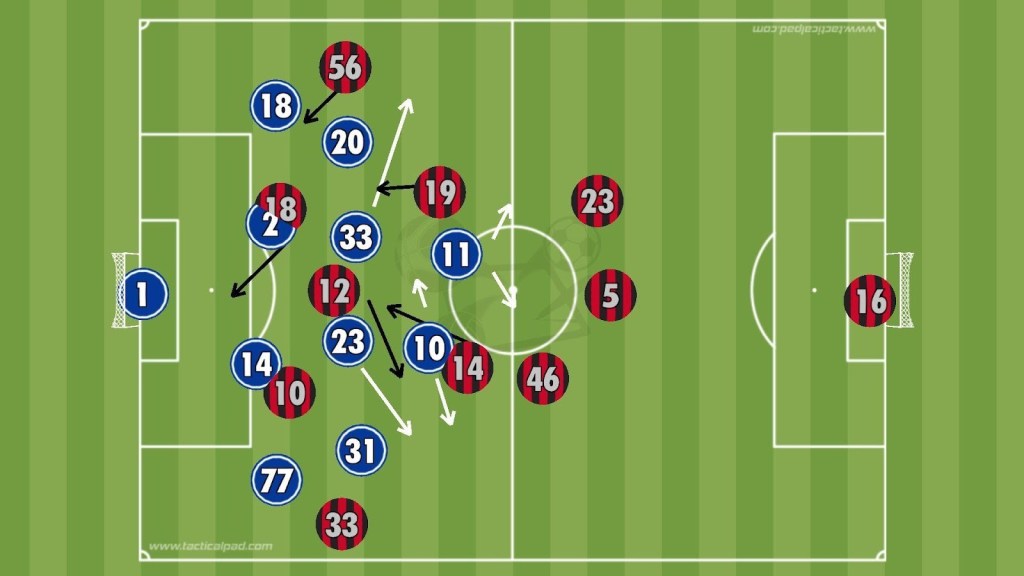
Two minutes later, following a Como throw-in, the ball deflected off Modrić and fell to Nico Paz. He evaded Fofana’s sliding tackle and quickly switched play to Baturina. Baturina returned the ball centrally to Nico Paz, who arrived on the run and struck a first-time shot. Maignan produced an outstanding save to deny Como a second goal.
In the 40th minute, Nico Paz carried the ball centrally and released Vojvoda on the right. Vojvoda beat Bartesaghi with a step-over, faked a cross, shifted onto his left foot, and delivered the ball into the box. Milan’s defenders failed to track Da Cunha, who headed the ball from close range. Once again, Maignan reacted brilliantly, blocking the effort with his face.
During Milan’s build-up, the right centre-back drifted wide, sometimes outside the box. De Winter shifted inside to the left, while Gabbia moved centrally to support progression. Modrić dropped close to the defence to help circulation. Rabiot and Fofana positioned themselves higher, with Rabiot often close to the forwards to maintain counter-attacking momentum. The wing-backs pushed forward, Nkunku stayed highest, and Rafael Leão floated as a second attacker, creating uncertainty for Como’s markers.
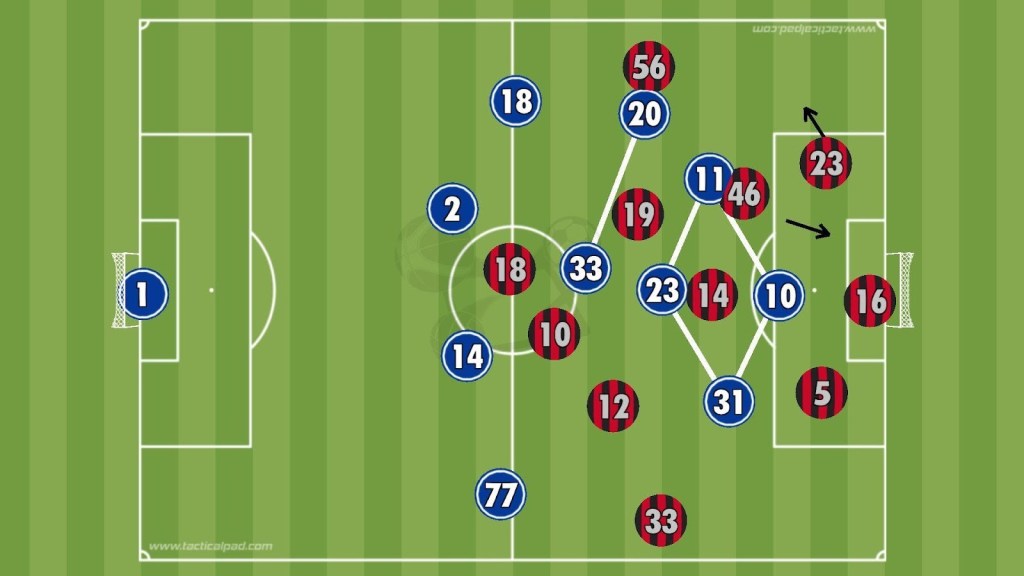
Como pressed aggressively, with Nico Paz leading the line. Douvikas drifted wide to act as a second attacker alongside Vojvoda. Perrone sat just behind them, forming a midfield diamond. Baturina and Da Cunha rotated behind, with Baturina moving wide and Da Cunha sometimes joining Perrone centrally. Como’s defensive line held a high position near the halfway line.
Under pressure near the corner flag, Milan struggled to escape. However, Modrić’s quality allowed him to break the press with a pass into Fofana, who shielded the ball and released Rafael Leão. Leão passed to Rabiot, who drove centrally and played Bartesaghi, before Tomori attempted a long pass. Como’s press forced a deflection, and Kempf immediately fed Alberto Moreno. He advanced and played Nico Paz through the middle, whose perfectly weighted through ball found Douvikas. Douvikas fired a contested shot towards the corner, but Maignan again made a crucial save in the 41st minute.
In the 43rd minute, Bartesaghi won the ball from Van der Brempt, who appealed for a foul. Bartesaghi advanced and played a simple through pass to Rabiot. After contact outside the immediate ball contest, the referee awarded a penalty. Following a VAR review, the decision stood, despite controversy.
In first-half stoppage time, Nkunku took the penalty. The strike was poorly executed, but despite the goalkeeper getting a touch, the ball trickled underneath him and crossed the line, bringing Milan level at 1–1.
The first half ended with Como clearly on top. Only Maignan’s heroics and a few missed chances prevented Como from extending their lead. Milan equalised through a controversial penalty, and the scoreline did not reflect the balance of play. Milan struggled to retain possession, bypass Como’s press, or contain their attacking movements.
The second half began with more Como dominance. In the 51st minute, Tomori lost a duel to Alberto Moreno, who crossed low into the box. Nico Paz arrived from midfield and struck a first-time shot towards the far corner, but Maignan once again produced a sensational save.
In the 55th minute, Alberto Moreno misplaced a simple pass to Da Cunha. Saelemaekers intercepted and delivered a superb long ball to Rafael Leão, who had already moved into the attacking half. Leão cut inside and chipped a delicate pass over the defence to Rabiot. Rabiot controlled with his chest and finished clinically, completing Milan’s comeback with a beautifully constructed move.
In the 59th minute, after the ball bounced around the area, it fell to Alberto Moreno, who passed to Nico Paz. Paz slipped as he shot, but the ball still struck the post, nearly restoring parity for Como. Despite a slight deflection, the referee awarded a goal kick.
In the 81st minute, Milan won a corner. Butez misjudged his run off the line, allowing the ball to reach Loftus-Cheek, but his header flew over the bar.
In the 88th minute, Tomori took a throw-in. After a contested duel, the ball fell to Rabiot, who controlled, drove centrally, and fired a powerful shot into the corner to seal the match at 3–1.
The second half again began with Como in control, with Maignan once more the decisive factor. As substitutions were made, Milan gradually asserted themselves. The game opened up into an end-to-end contest, and although Milan’s defence remained vulnerable, it was enough to secure the victory. Como created numerous chances but failed to capitalise, more due to misfortune than poor execution.
Milan maintained their unbeaten run and ended Como’s home record, largely thanks to Maignan, who was the standout performer. Saelemaekers and Rabiot also played key roles in the win. Ultimately, Milan’s individual quality proved decisive against an impressive Como side. With this victory, Milan continue their pursuit of Internazionale at the top of the table.
Written by Israel Schmidt de Azevedo


 INMR FOOTBALL
Leave a comment