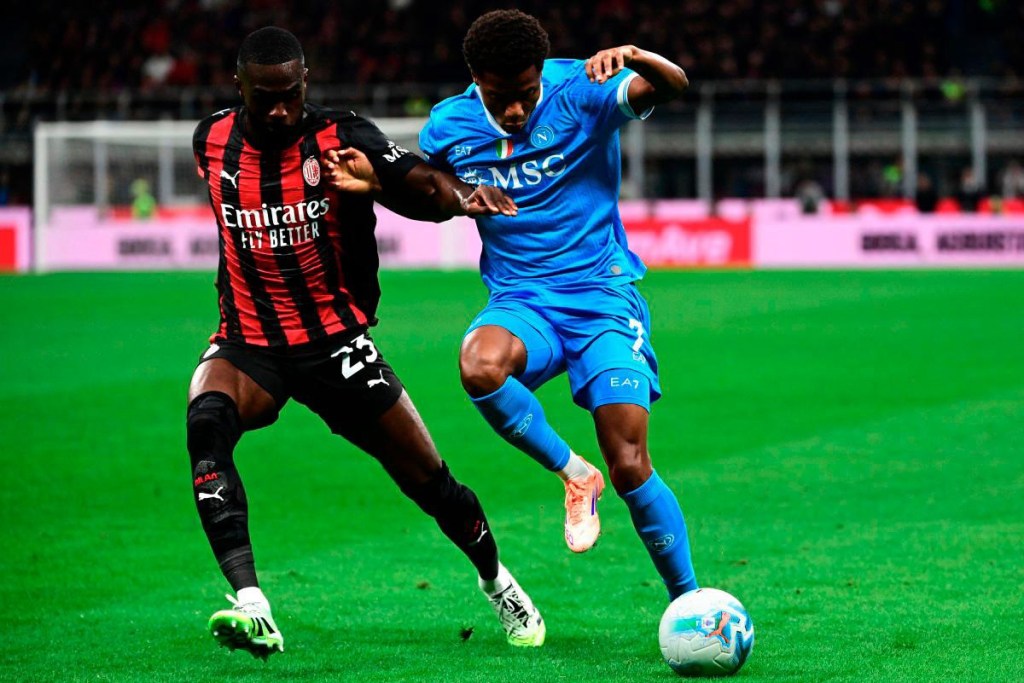
AC Milan held off a late Napoli surge to claim a 2–1 win at San Siro, despite playing the final half-hour with ten men. Early goals from Christian Pulišić and Alexis Saelemaekers punished Napoli’s high line before Kevin De Bruyne pulled one back from the penalty spot. In this analysis, Israel Schmidt de Azevedo breaks down how Milan’s compact structure and counter-attacks shaped the game.
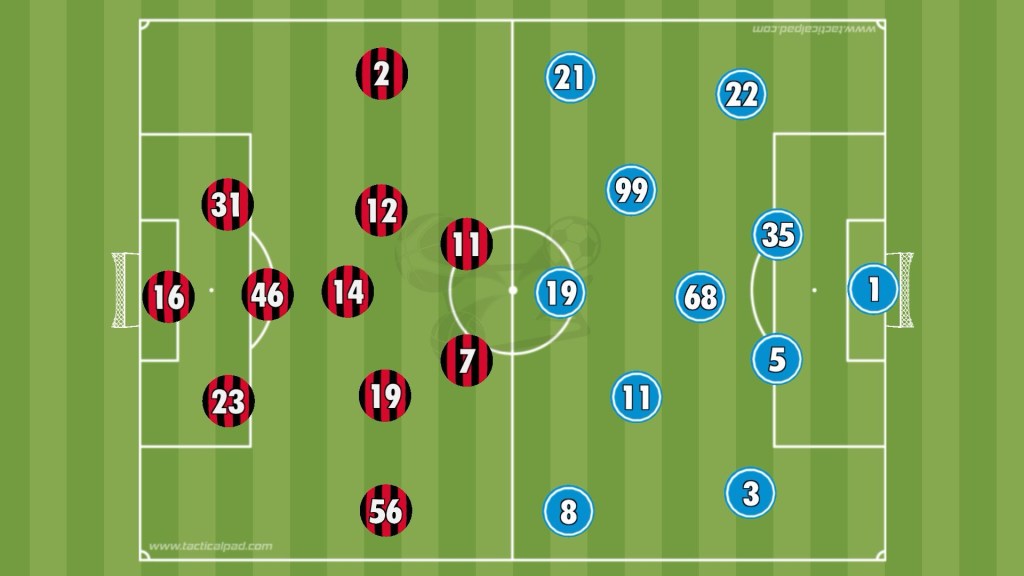
Milan’s 2–1 win over Napoli was shaped by two distinct tactical periods. In the first, Napoli controlled possession while Milan maintained a compact mid-block, closing central gaps and limiting passing lanes. Whenever they won the ball, Milan slowed the tempo to disrupt Napoli’s rhythm and set up quick counter-attacks.
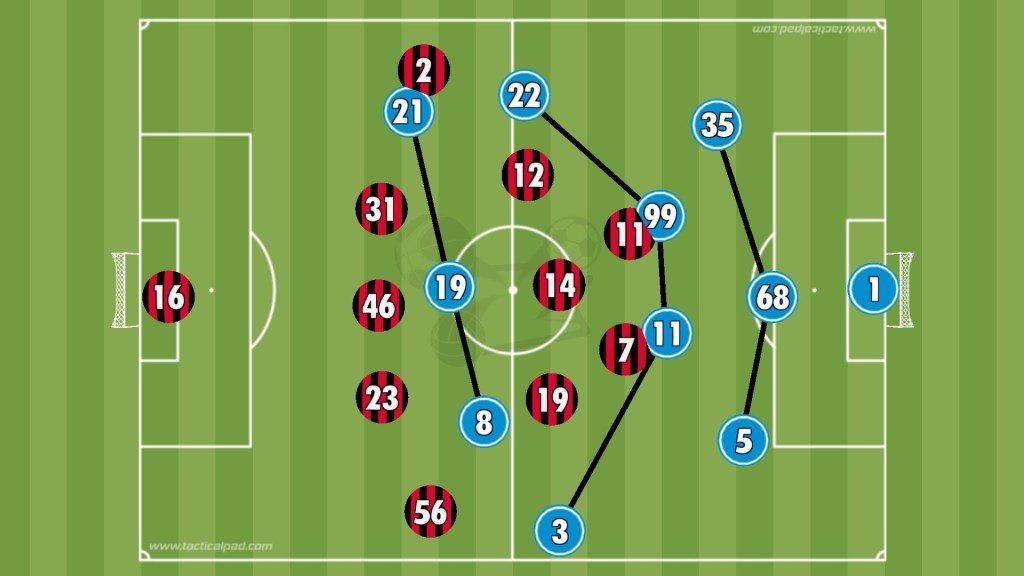
As Napoli pushed high, their back line advanced close to the halfway line to compress the field. Gianluca Scamacca led the first press alongside André-Frank Zambo Anguissa, who moved forward from midfield, with Scott McTominay and Matteo Politano wide and Kevin De Bruyne drifting between the lines as a mezzala. Stanislav Lobotka sat deeper as a holding midfielder, almost functioning as a libero.
Milan adapted by shifting Fikayo Tomori into a right-back role and bringing Pervis Estupiñán deeper to form a back four. Luka Modrić dropped into the defensive midfield zone to aid the build-up and transition, while Youssouf Fofana and Adrien Rabiot patrolled central areas. Christian Pulišić and Alexis Saelemaekers stayed wide, providing pace on the counter, with Santiago Giménez operating as the focal point.
That plan paid off early. In the third minute, Pavlović found Estupiñán, who released Pulišić down the left. The American skipped past his marker and crossed to the far post, where Saelemaekers finished at the first attempt to give Milan the lead on their very first counter-attack.
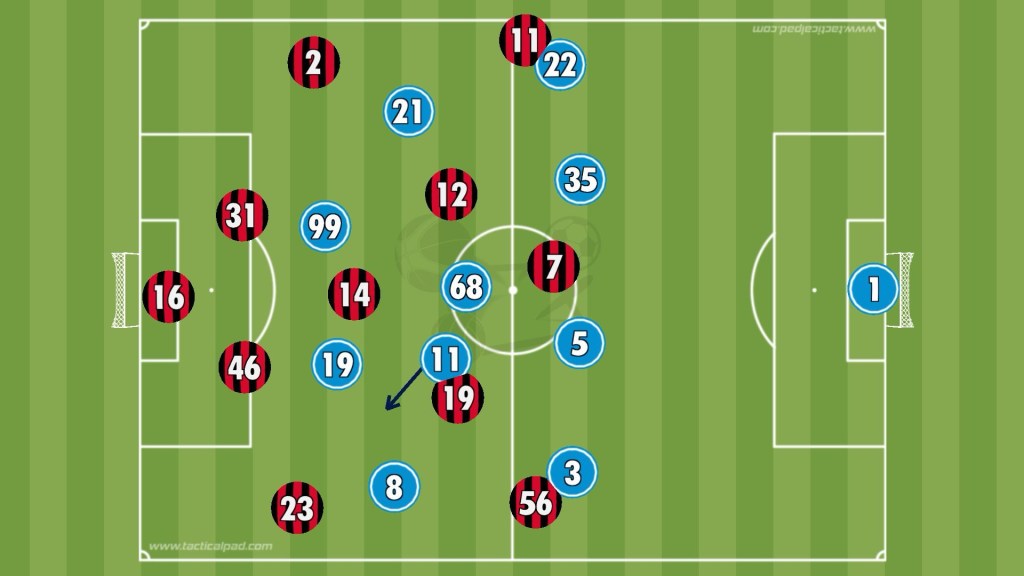
In the 17th minute, after a Modrić corner, Pavlović attempted an overhead kick that looped over the bar, while ten minutes later Pulišić sent a superb through ball to Fofana, whose shot grazed the crossbar. Milan doubled their lead in the 31st minute. Pavlović surged forward and crossed for Fofana, who cushioned the ball for Pulišić to strike first-time into the bottom corner.
Napoli struggled to break Milan’s compact shape. A 37th-minute appeal for a penalty against Tomori was dismissed after a VAR review, and at 40 minutes De Bruyne’s clever pass nearly found Giovanni Di Lorenzo, only for Mike Maignan to deny him.
To regain control, Napoli widened their defensive line with Marianucci and Juan Jesus pushing wide, and Lobotka dropping deeper to orchestrate play. De Bruyne and Anguissa dropped into deeper positions to accelerate transitions, while Di Lorenzo and Gutiérrez advanced to create width. McTominay and Politano supported Rasmus Højlund centrally in a more fluid attacking setup.
Milan responded by forming a deeper defensive block, with Estupiñán and Saelemaekers joining the back line to create a five-man defence. Modrić anchored midfield behind Rabiot and Fofana, while Pulišić and Giménez remained higher to threaten on the break.
In the second half, Napoli finally found a breakthrough. In the 54th minute, Politano’s cross led to a scramble that ended with Di Lorenzo being pulled back by Estupiñán. After a VAR review, the foul was upgraded to a red card and a penalty. De Bruyne calmly converted, sending Maignan the wrong way to make it 2–1.
With the numerical advantage, Napoli pressed high. Lobotka dictated the tempo, Anguissa crossed dangerously in the 75th minute, and late efforts from Noa Lang and David Neres tested Maignan again. In stoppage time, Neres struck the bar with a deflected shot before forcing another fine save in the 97th minute.
Despite intense late pressure, Milan held firm. Their compact defensive structure and efficient counter-attacks in the first period proved decisive. Napoli’s high line was repeatedly punished, and even after the red card, Milan showed composure to secure a hard-fought victory.
Rafael Leão also made his return from injury, offering further encouragement for Milan ahead of the coming fixtures.
Written by Israel Schmidt de Azevedo


 INMR FOOTBALL
Leave a comment