

Following the shocking news that Jamie Vardy would leave Leicester City, football fans everywhere were left wondering: where will he play next?
After a transfer window full of speculation, it was the newly promoted Italian side Cremonese who secured the signature of the legendary centre-forward.
Embed from Getty ImagesCremonese sought to bolster their attack by signing Vardy as a free agent, an incredible opportunity in the transfer market that could not be missed. Although far from his prime, Vardy remains pacy for his age. While his top speed has naturally declined, his explosiveness is still sharp, which makes him a valuable tactical asset for Cremonese. His numbers prove that he still has what it takes to make a difference in their campaign.
Vardy’s statistics are not bad, even if not as high as in the past, and he is certainly not a player to ignore. With nine goals and four assists, he contributed significantly to Leicester.

His figures were heavily influenced by Leicester’s poor season in the Premier League, but he still managed to stand out in several matches, even earning a place in the Premier League Team of the Week.
He produced progressive passes, but his real strength lay in ball progression through carries using his speed and dribbling ability to drive towards goal.
He also contributed with crosses despite being the main centre-forward, often drifting wide to deliver or create plays. Interestingly, despite his respectable number of goals and assists, Vardy had a low percentage of touches, underlining how lethal he can be with limited involvement.

He is most prolific when attacking space, running behind defenders, and positioning himself to receive the ball one-on-one with the goalkeeper, either to finish or to set up a chance.
His defensive numbers also suggest he participates in high pressing, working to win the ball back in advanced areas and forming the first line of resistance, though sometimes a little clumsy in execution.

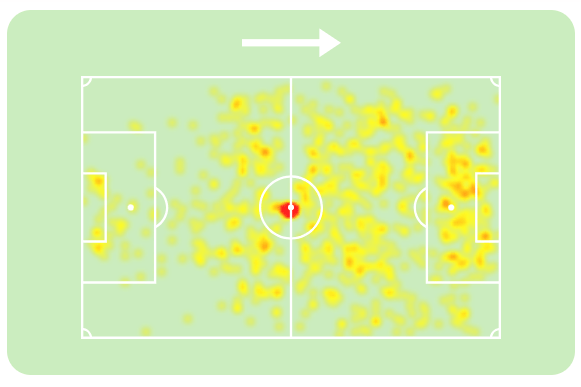
Vardy’s heatmap shows movement across almost the entire opposition half, constantly looking to receive the ball and exploit spaces. He often contested long balls, either heading them on or controlling to protect possession. His constant runs across the opposition’s defence disrupted their attempts to build from the back.
Cremonese typically play a 3-5-2, with both wing-backs dropping into full-back roles when defending. They are comfortable conceding possession, as they did in Serie B, relying instead on a solid defence and fast transitions. These transitions often involve long ball carries and wide deliveries which are the exact situations where Vardy thrives, running with the ball and creating danger.
With two established forwards in attack, Vardy will have freedom to orbit around a partner as a second striker, exploiting space off a pivot, as Cremonese have played so far.
The team also switches into a 4-4-2 or 5-3-2 at times, or forms a diamond with a clear centre-forward pivot. These variations could suit Vardy’s defensive and transitional style of play. His experience, combined with his explosiveness, speed, and intelligent movement into space, may give Cremonese the edge they need to secure a strong season. His ability to carry the ball in counter-attacks could also be a key weapon for both him and the club.
Embed from Getty ImagesWritten by Israel Schmidt de Azevedo




 INMR FOOTBALL
Leave a comment