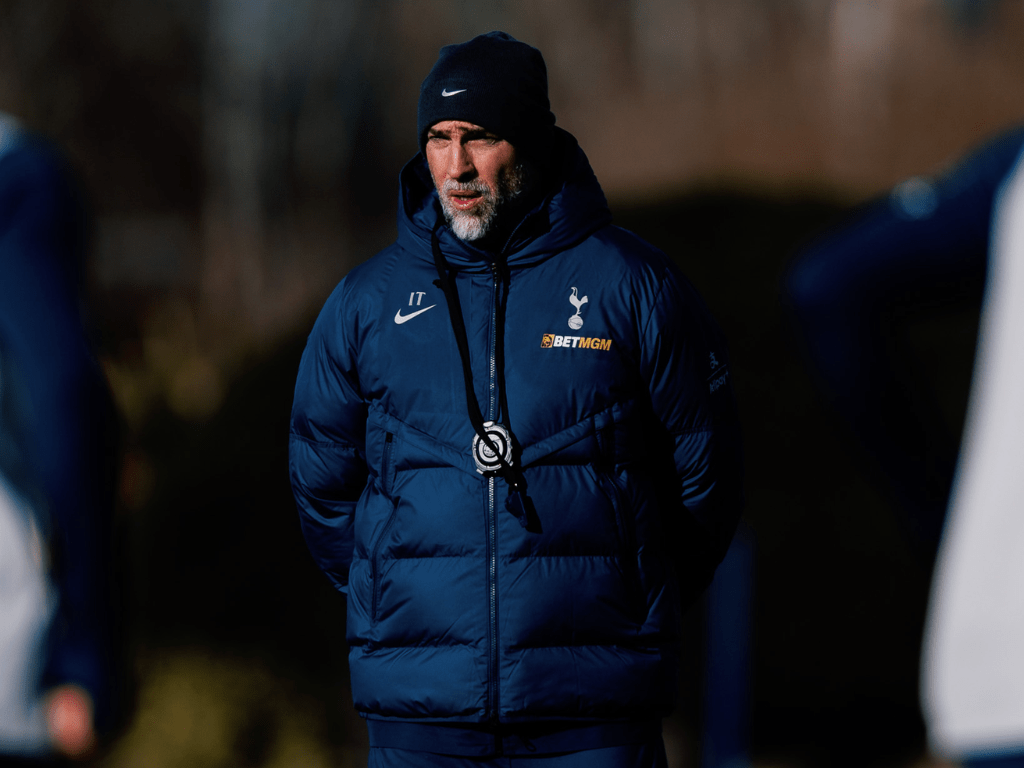
Igor Tudor is set to take his first match in charge for Tottenham as they face Arsenal in the North London Derby this Sunday. Israel Schmidt de Azevedo explains Tudor’s tactics.
Embed from Getty ImagesIgor Tudor prefers a 3-4-3 system, with two wing-backs positioned high and wide to stretch the opposition’s defence and support play down the flanks, which is one of his main focuses. His teams are built around counter-pressing, verticality, long balls and crosses. They do not aim to dominate possession; instead, they prioritise quick progression, using direct passing and long balls to break through high pressing lines and reach the final third as quickly as possible. On occasion, his sides can retain possession, but the overall structure is designed for transitions, relying on the quality of central midfielders such as Thuram at Juventus. Intensity is a fundamental principle in Tudor’s approach.
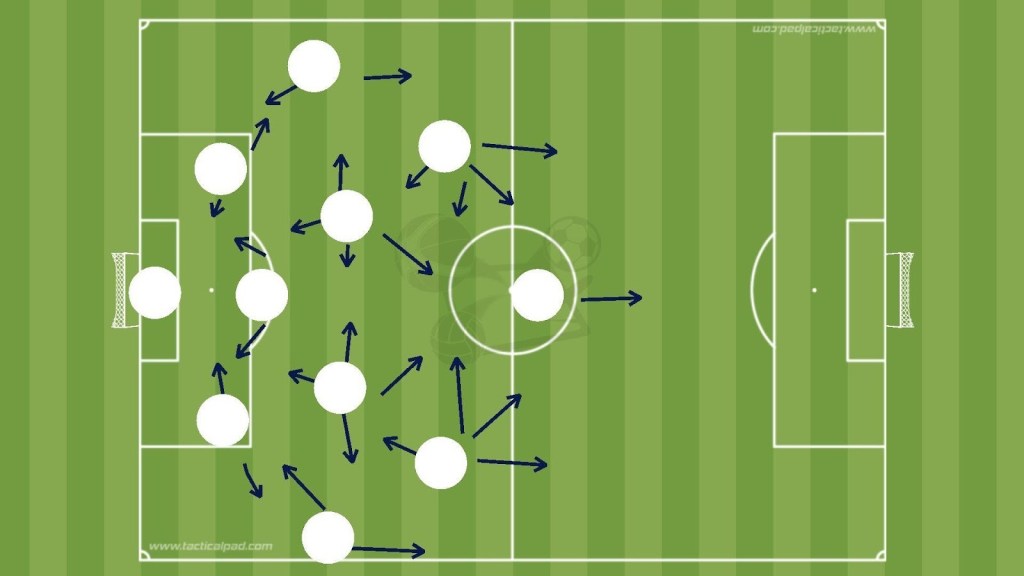
Low Build-Up
Tudor typically begins his low build-up with a back five, using mobile full-backs. The two central midfielders stay close to the defence to support combination play. The two second attackers operate as wingers, helping advance the ball into the attacking half by exploiting the width, though they can also cut inside to build centrally, forming a 5-2-3 shape.
The system can shift by moving one centre-back wider to operate as a right or left-back — at Juventus, Kalulu often performed this role on the right. This adjustment allows one full-back to push higher as a wing-back again, while one second attacker moves centrally as an attacking midfielder or even drops into midfield, forming a triangle. This can resemble either a 4-3-3 or a 4-5-1.
The aim is to progress from defence through quick combinations, attacking the space that opens once the first line is broken. If short build-up proves difficult, the structure also supports long balls towards the centre-forward, who is expected to hold up play and bring wing-backs or wide attackers into action. The objective is to reach attacking positions with minimal touches, using constant movement to disrupt markers.
High Build-Up
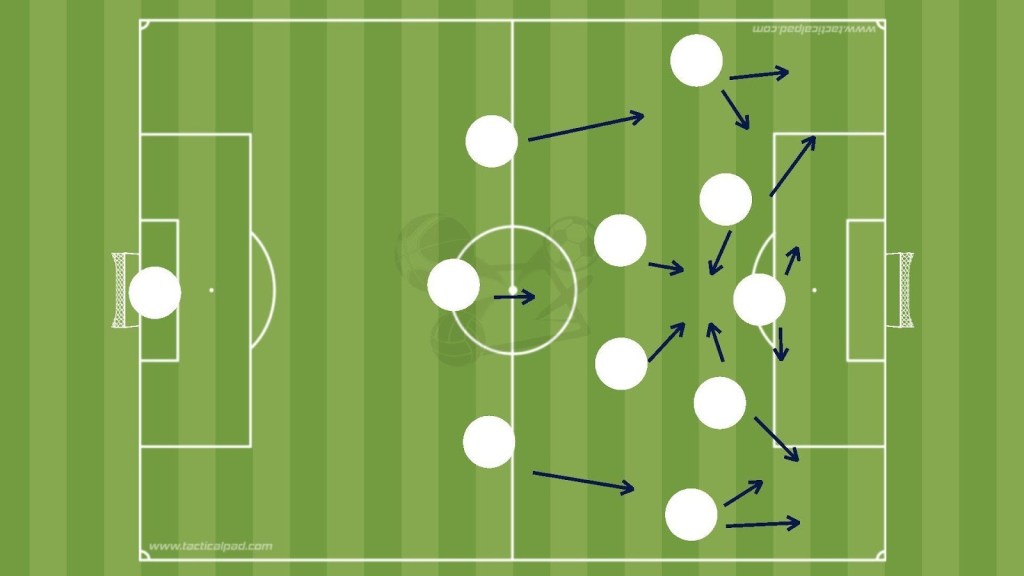
In high build-up phases, Tudor wants numbers around the penalty area. The back three hold a high line near halfway. The two central midfielders operate within a compact attacking line alongside the front three, occasionally stepping into the box to overload it.
Both wing-backs push forward to act as wingers, forming a line of five in attack. They look to deliver crosses or combine with the second attackers in wide areas. The second attackers position themselves near the box, stepping inside or drifting wide to combine, and at times dropping into an attacking midfield role to create centrally. When this happens, the central midfielders are free to advance and attack the area, as seen with Thuram or Locatelli.
The centre-backs initiate play from deep but may also carry the ball forward to create overloads on the flanks. Occasionally, the central centre-back steps into midfield to create a temporary three-man structure, allowing others to push on.
The team often operates in a 3-2-5, with five players occupying the box or its edges, focusing on crosses. At times it resembles a 1-4-5, with wide centre-backs advancing into midfield areas. The primary aim is to move the ball quickly to the wingers or second attackers, either to deliver crosses or to attack central spaces through dribbling.
Tudor is tasked with improving performances and steering the club away from the relegation zone. The board’s decision reflects belief in his ability, but there are factors to consider. Tudor has rarely stayed more than one season at a club. At both Olympique Marseille and Lazio, his spells were short, ending by his own choice. He also has a history of tension with club management.
Another concern is that when a team is close to relegation, defensive stability is usually the first priority before attacking improvements. Tudor’s recent spell at Juventus was marked by inconsistency, a high number of goals conceded and a relatively low scoring output — the opposite of what Tottenham require.
There were also concerns about lethargy in his Juventus side. Despite aiming for intensity and counter-pressing, the team often appeared slow and out of rhythm in both attack and defence. Serie A is physical and demanding, but the Premier League demands even greater intensity. If similar issues arise, Tottenham risk being overwhelmed, deepening their crisis.
Tottenham supporters now want a coach capable of making an expensive squad perform at its level and sustaining success over several seasons, targeting progress in both the Premier League and Champions League. Tudor will hope to replicate the strong campaign he produced at Marseille. With that ambition in mind, Tottenham enter what may be the decisive final chapter of their season.
Embed from Getty ImagesWritten by Israel Schmidt de Azevedo

 INMR FOOTBALL
Leave a comment