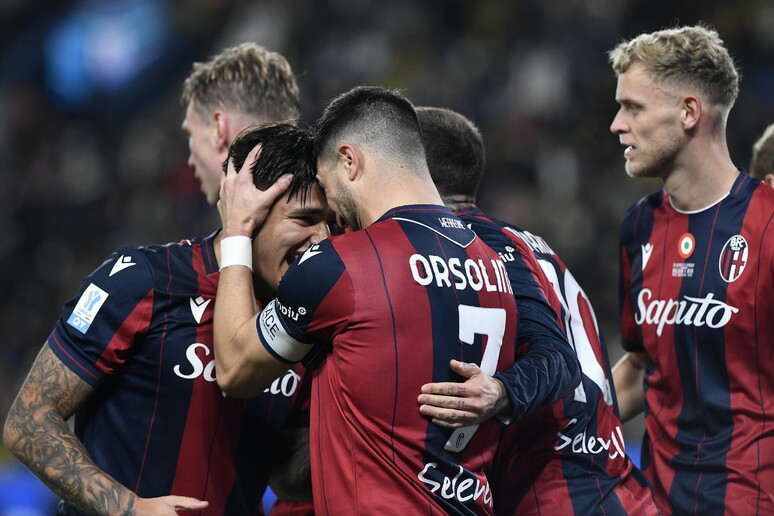
Inter struck early in the Supercoppa semi-final but were eventually held and eliminated as Bologna edged a dramatic contest on penalties after a 1–1 draw. Marcus Thuram’s second-minute opener set the tone, before Riccardo Orsolini equalised from the spot to pull Bologna level.
Both sides had chances to win it in normal time, with the goalkeepers producing key saves, but the tie was ultimately decided in a tense shootout, where Bologna prevailed to book their place in the final. Below, Israel Schmidt de Azevedo breaks down the tactical themes that shaped the game, from Inter’s early aggression to Bologna’s growing control and resilience.

When building play from their own half, Bologna slightly shifted the right centre-back wider while the left-back moved inside, closer to the defensive line. Jhon Lucumí stepped forward to operate as a libero, drifting into a defensive midfield role, with both central midfielders positioned close to him to help progress the ball quickly. The left midfielder dropped into the left-back zone, while the right-back advanced to operate as a right wing-back. Both the central midfielder and the left midfielder pushed forward as second attackers.
Inter adjusted by moving Henrikh Mkhitaryan into a left midfield role, while Piotr Zieliński stepped higher from defensive midfield to play as a left-sided central midfielder. Federico Dimarco dropped deeper to operate as a left-back, with Yann Bisseck shifting from right centre-back to right-back. Inter’s approach paid off early: in the 2nd minute, Alessandro Bastoni stepped in front of Santiago Castro to win the ball, carried it past two defenders, and delivered a cross to the far post where Marcus Thuram finished with a superb half-volley to open the scoring.
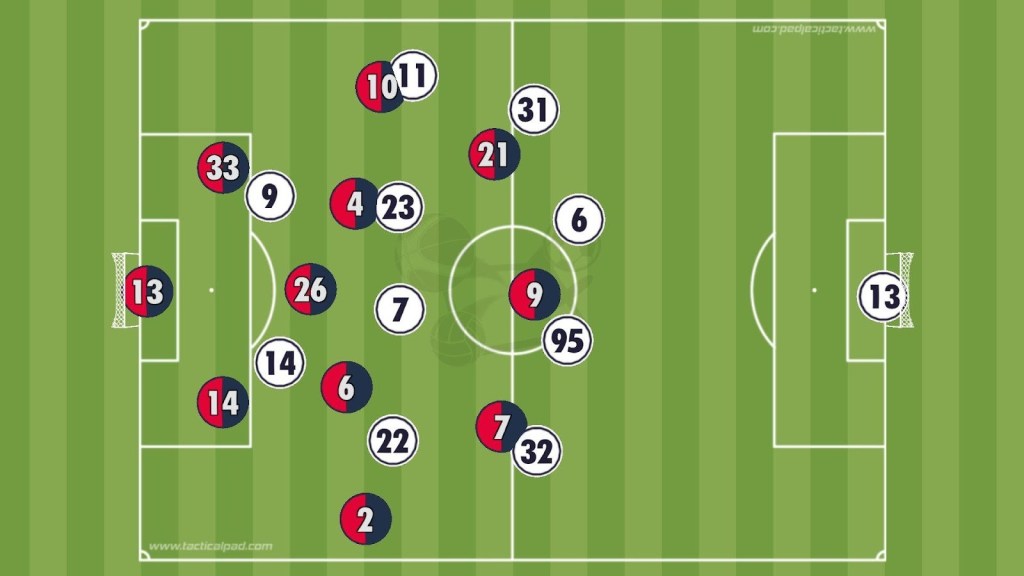
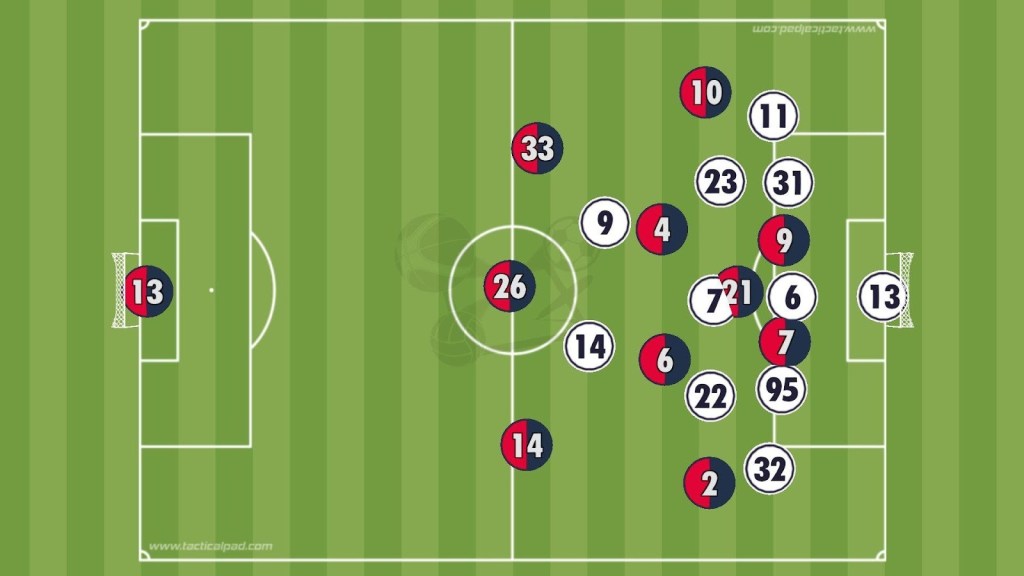
When pressing, Bologna pushed both Castro and Riccardo Orsolini forward as attackers. Jens Odgaard dropped into midfield, with Tommaso Pobega stepping higher to support the press. Nikola Moro drifted wide to the right midfield role, with Federico Bernardeschi operating on the opposite side. Both full-backs advanced into the attacking half, while the centre-backs held a high line near the halfway line.
Inter attempted to bypass this pressure by shifting Bisseck wider as a right-back and dropping Dimarco deeper from wing-back to left-back. Zieliński and Nicolò Barella dropped closer to the defensive line to offer central passing options. Luís Henrique moved from right-back into a wide right-wing role, while both forwards adjusted their movement, with Thuram adopting Lautaro Martínez’s usual roaming role around Ange-Yoan Bonny. Mkhitaryan drifted wide on the left as a winger.
In the 4th minute, Dimarco found Bonny with a long ball over Bologna’s pressing line. Bonny drove at Lucumí, cut inside, faked a shot, and then shifted the ball left, sending the defender sliding. Despite the quality of the move, his finish was poor and went wide, with the assistant referee subsequently raising the flag for offside.
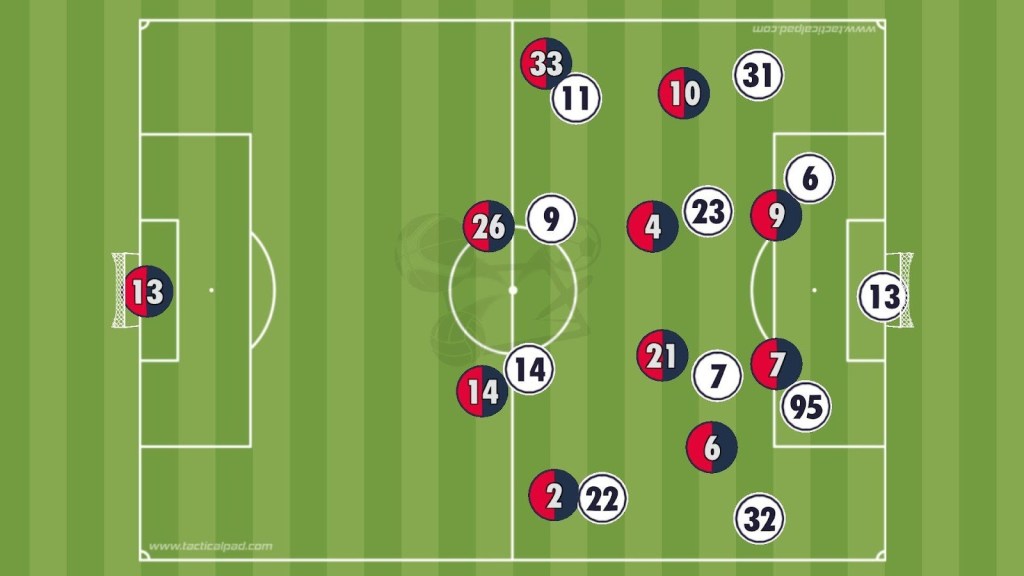
Defensively, Inter narrowed their shape, with wing-backs dropping to form a back four alongside the centre-backs. The midfield line stayed wider, with both central midfielders positioned either side of the defensive midfielder. The two forwards remained high, ready to launch counter-attacks.
Bologna attacked by pairing Orsolini and Castro up front, with Orsolini occasionally drifting wide. Odgaard operated just behind them as an attacking midfielder, sometimes stepping up as a centre-forward and pushing the attackers slightly wider. Behind them, the right-back moved into right midfield, while both central midfielders advanced towards the edge of the attacking third. The centre-backs and left-back formed a three-man defensive base to protect against counter-attacks.
In the 10th minute, Orsolini carried the ball past Dimarco, Mkhitaryan and Bastoni before finding Pobega, who quickly played Odgaard into the area. Odgaard reached the byline and cut the ball back, but Castro failed to connect cleanly and the effort went just wide.
In the 22nd minute, Orsolini released Odgaard down the right. Odgaard feinted a cross with his right foot before delivering a low left-footed pass into the box for Emil Holm. Holm laid the ball back to Bernardeschi, who attempted a placed left-footed finish, but the shot went straight at the goalkeeper.
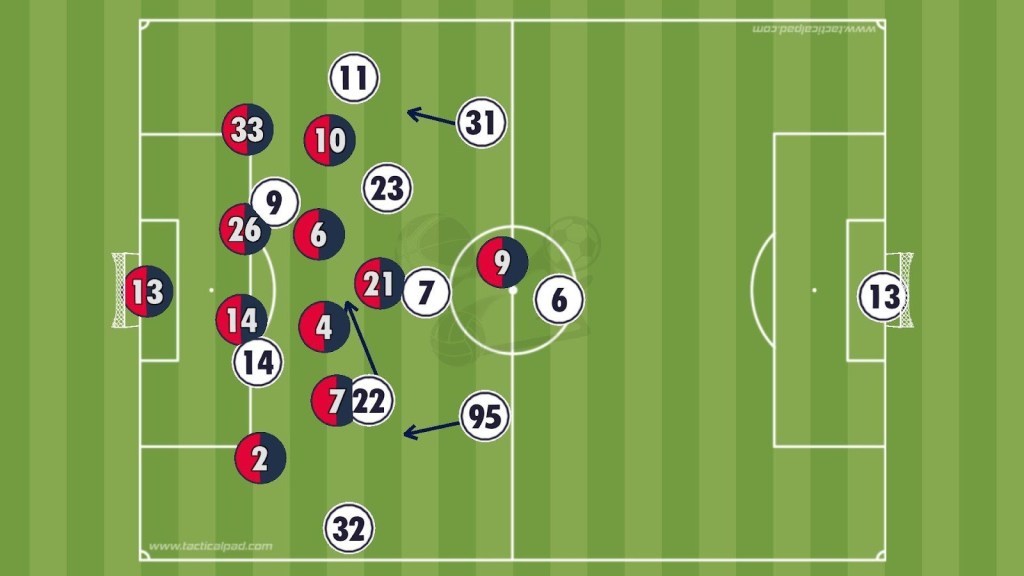
When defending, Bologna narrowed the space between their centre-backs and full-backs, dropping their wide midfielders into wing-back roles. Odgaard stayed ahead of the midfield line, with the centre-forward positioned as the highest player.
Inter attacked with both forwards occupying the box, wing-backs pushing high on both sides, and the midfield line stepping forward to support. Mkhitaryan frequently moved centrally into an attacking midfield role, while both wide centre-backs advanced into the attacking half to sustain pressure.
In the 25th minute, Zieliński drove forward and slipped a through ball to Dimarco, who ran beyond the defence and reached the byline. His low cross found Zieliński in the six-yard box, but the effort was too close to the goalkeeper. The rebound fell to Bonny, who spun onto his left foot, but after a challenge the goalkeeper managed to recover and push the ball out of play.
In the 32nd minute, the referee was called to the monitor to review a potential handball by Bisseck. After the VAR check, a penalty was awarded. Orsolini stepped up in the 35th minute and calmly converted down the middle to equalise for Bologna.
In the 53rd minute, Luís Henrique cut inside from the right and unleashed a powerful shot, but Łukasz Skorupski was equal to it. Three minutes later, Mkhitaryan won possession and played Bonny through on goal. Bonny shielded the ball and went down under contact in the area, initially earning a penalty, but after VAR review the decision was overturned as he had initiated the contact.
In the 80th minute, Lautaro Martínez received a pass from Diouf, drove into the box and fired towards the near corner, forcing a strong save from Ravaglia. Deep into stoppage time, Cambiaghi collected a throw-in, battled past his marker, and crossed from the byline. After multiple deflections involving Jonathan Rowe, Bastoni and Dimarco, the ball fell to Fabian, whose placed shot was brilliantly saved by Martínez to preserve the draw.
The match went to penalties. Lautaro converted first for Inter, with Lewis Ferguson responding for Bologna. Bastoni’s weak effort was saved by Ravaglia, while Moro saw his penalty saved by Martínez. Barella then blazed over, only for Miranda to do the same. Bonny’s tame fourth penalty was easily saved, before Jonathan Rowe scored to give Bologna the advantage. Stefan de Vrij struck the post but saw the ball go in to level things again, before Ciro Immobile sealed the shootout with a superb finish into the opposite corner, winning it 3–2 for Bologna.
Inter’s early goal shaped the match, as they allowed Bologna possession while looking to strike through counter-attacks and aggressive pressure. From the middle of the first half, Bologna began to grow into the game, creating chances and eventually equalising from the spot. Inter regained control after the goal but continued to prioritise transitions. The second half produced fewer clear chances, with goalkeepers playing key roles. In the shootout, Inter paid for poor execution, while Bologna held their nerve to advance and set up a final against Napoli. Bologna arrive as underdogs once again, but their organisation and resilience suggest they should not be underestimated.
Embed from Getty ImagesWritten by Israel Schmidt de Azevedo


 INMR FOOTBALL
Leave a comment