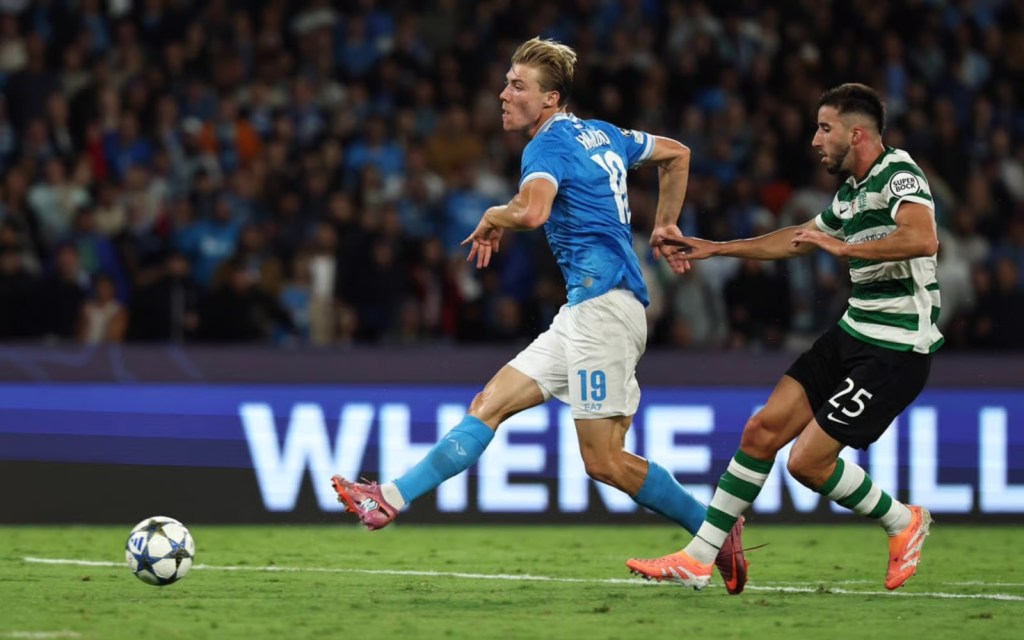
Napoli edged past Sporting 2–1 in a tightly contested tactical battle defined by pressing duels and compact defensive systems. Rasmus Højlund’s brace, both assisted by Kevin De Bruyne, proved decisive after Luis Suárez had equalised from the spot. In this analysis, Israel Schmidt de Azevedo explores how Napoli’s structure adapted to Sporting’s disciplined low block and how their direct transitions made the difference.
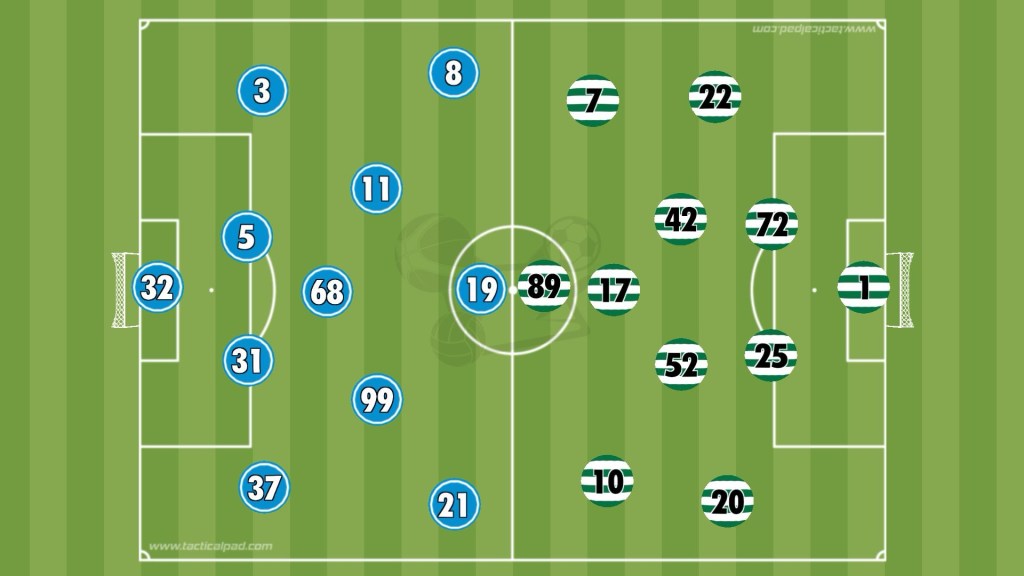
Napoli and Sporting played out a fascinating match built on organisation, transitions, and structure. Both sides are known for their quick combinations and vertical play, but Sporting’s compact defensive block made Napoli struggle when forced to build up rather than counter-attack. Despite that, Sporting remained brave on the break, ready to punish any Napoli mistake.
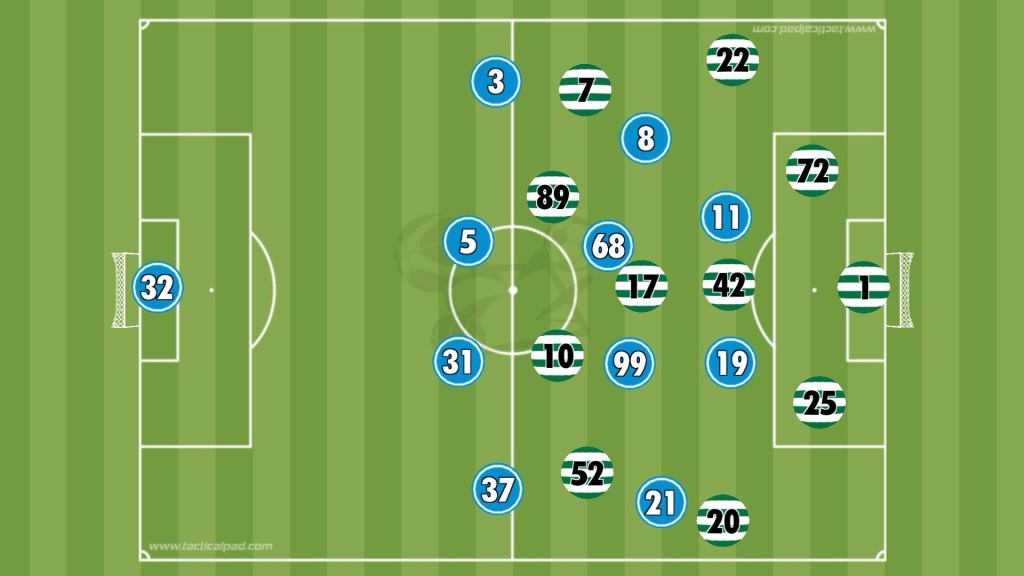
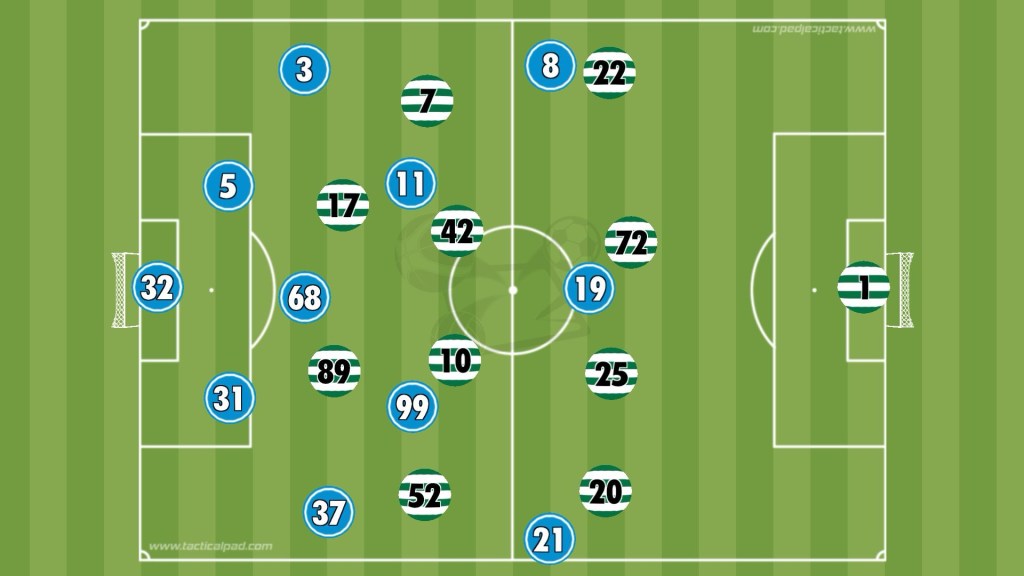
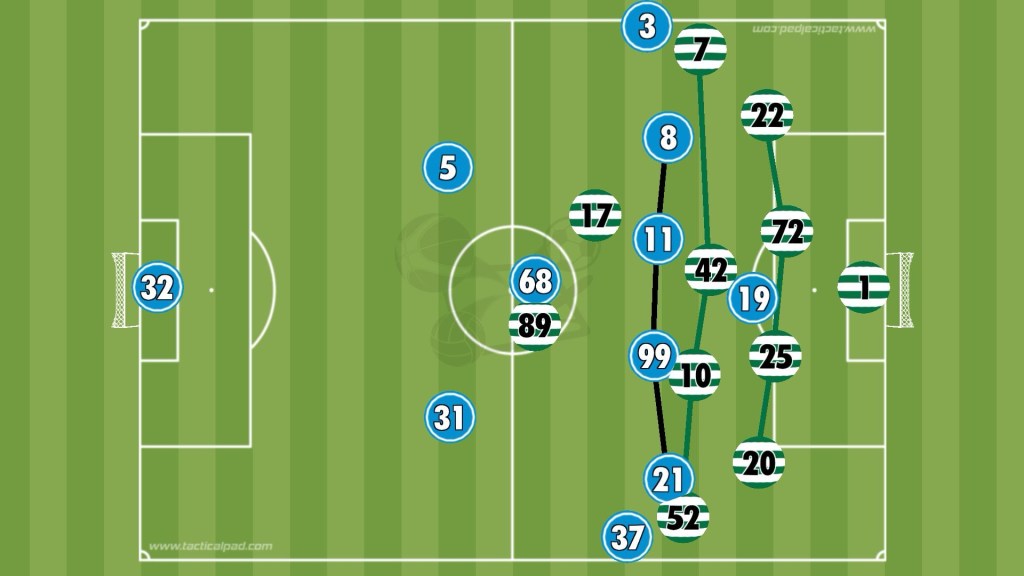
When pressing, Napoli pushed Rasmus Højlund and Kevin De Bruyne into the first line, supported by Stanislav Lobotka stepping forward from holding midfield alongside André-Frank Zambo Anguissa. Scott McTominay and Matteo Politano tucked in to form a second pressing line of four, while the defensive unit held a high position near the halfway line.
Sporting countered by opening both centre-backs inside the penalty area, with full-backs positioned wide to stretch the play. Morten Hjulmand dropped deep as a libero, with Francisco Trincão just ahead of him to link the lines. Ioannis Loannidis and Geny Catamo stayed central, while Simões and Quenda provided width, a setup designed to break Napoli’s press quickly and launch transitions.
That pattern defined most of the match. When Sporting pressed, Trincão and Loannidis formed the first line, behind which Quenda and Simões stayed wide, while Catamo and Hjulmand operated centrally. The back line remained deeper than usual, focused on nullifying Napoli’s counter-attacks.
Napoli mirrored Sporting’s structure when building, spreading their defenders across the box, with advanced full-backs and Lobotka dropping between the centre-backs as a libero. De Bruyne and Anguissa played as attacking midfielders, almost as mezzali, while Politano and McTominay stretched play on the flanks and Højlund led the line.
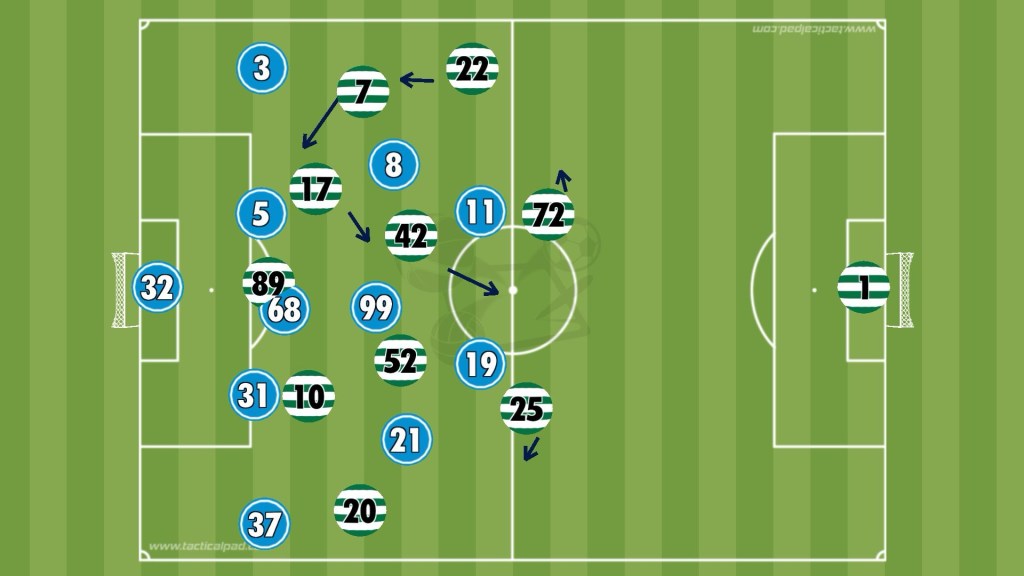
That structure paid off in the 36th minute. Anguissa found De Bruyne between the lines, and the Belgian carried the ball through two defenders before threading a perfectly weighted pass to Højlund. The striker’s composed finish gave Napoli the lead.
At 41 minutes, another counter saw Politano cut inside and shoot low, but Rui Silva produced a fine save. Although rare, Sporting also enjoyed spells of possession, trying to create from deep and push Napoli back. When building, they positioned Catamo and Trincão as secondary forwards, with Hjulmand occasionally dropping between the centre-backs.
Napoli defended with a line of five, Lobotka sitting just ahead as a shield. Anguissa moved centrally, supported by McTominay and Politano, while De Bruyne and Højlund formed the first pressing pair.
In the 61st minute, Pedro Gonçalves combined with Hjulmand and struck from range. His shot deflected to Araújo, who was brought down by Politano, the referee awarded a penalty. Luis Suárez converted to level the match.
At 79 minutes, De Bruyne again found space on the left and delivered a precise cross to Højlund, who headed in his second of the match to restore Napoli’s lead.
In stoppage time, Quenda crossed from the right for Hjulmand, who attacked the space brilliantly, but Ivan Milinković-Savić made a remarkable save with his trailing leg to deny Sporting an equaliser.
The match showcased two well-organised systems cancelling each other out for long stretches. The first period was tactical and cagey, while the second opened up as both sides sought control. De Bruyne’s vision and Højlund’s movement proved decisive, while Milinković-Savić’s late stop sealed the win for Napoli.
Written by Israel Schmidt de Azevedo


 INMR FOOTBALL
Leave a comment