
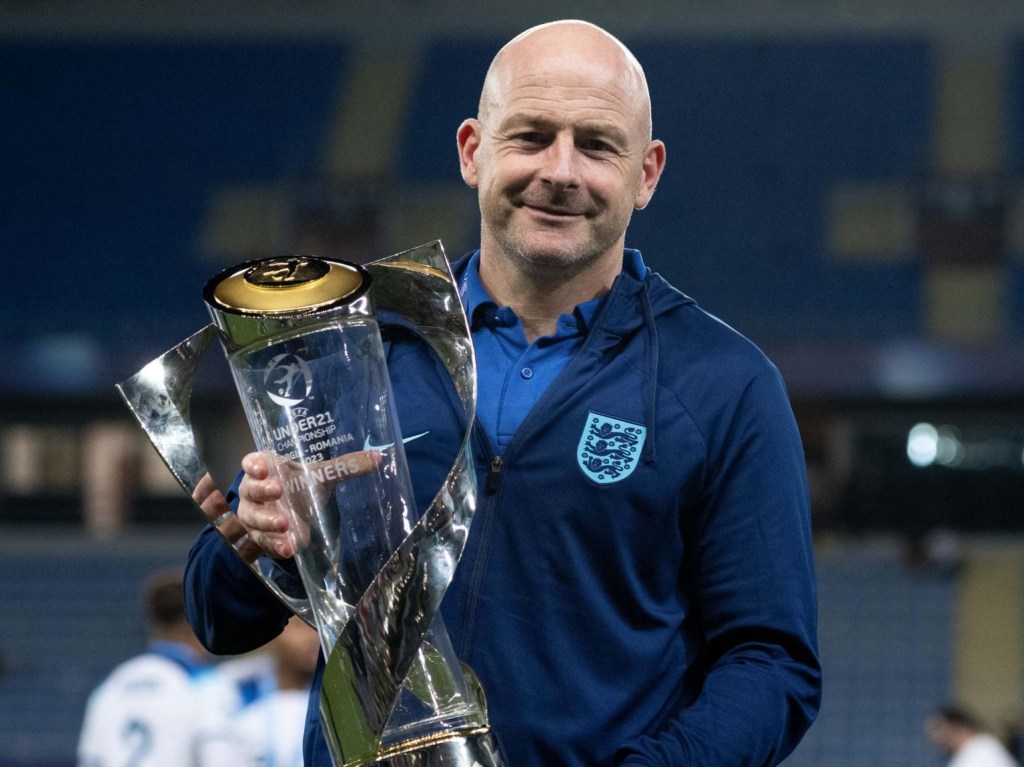
Following Gareth Southgate’s departure, England announced that U21 manager Lee Carsley would be taking over on an interim basis. In this article, INMR explains Lee Carsley’s tactics and how he might set up the England squad in the Nations League.
Carsley has favours a 4-2-3-1 formation in-possession, which is a structure that allows for lots of freedom in the early build up. His aim is to dominate the ball, but it isn’t constant possession. Instead, there is freedom of movement and rotation that eventually opens up space for the forwards to exploit.
A double pivot in midfield has often been key to this, sometimes operating ahead of an adapted back-line trio, with a fourth defender moving higher to overload the midfield. This is usually one of the full-backs, allowing the winger ahead to narrow. Carsley’s team then has an extra central body to help control possession in key areas.
Embed from Getty ImagesThis has been seen on both sides of the pitch, with central midfielders also rotating the other way on occasion; especially against sides who defend by man-marking. Carsley has frequently used players in different roles for England than the ones they play for their clubs. For example, he has used Cole Palmer in much deeper, pivot roles to assist in the build-up.
A particularly clever movement Carsley’s Under-21 side has shown is when the winger briefly swaps with the full-back. This allows the attacker to receive to feet, albeit much deeper. The key here is that they avoid all defensive pressure, as their advancing full-back teammate occupies the opposing full-back.
From here, the receiving attacker can drive forward from deep, unopposed. They can then combine with pace to break lines through the support of the pivots, temporarily high full-back, or central attacking players. Carsley’s ideas place a lot of trust in his players as he uses them in a very dynamic fashion.
Embed from Getty ImagesAttacking the final third
Once into the final third, one winger provides maximum width and the forwards were supported by a pivot and two narrowed full-backs. These movements have helped to better disrupt opposing blocks, as teams quickly sit off England when they cleanly build and begin to dominate possession. With the responsibility Carsley gives his players, they have adapted and changed roles in possession, to support attacks in wide areas.
Anthony Gordon and Morgan Gibbs-White are examples of players Carsley has used in roles that differ from their club positions. Both have, on occasion, led the front line. Naturally, both have drifted and rotated from this starting position into wide areas.
Embed from Getty ImagesInside-channel runs have also been key for Carsley. The spaces around and inside the opposing full-backs have been consistently targeted during England’s attacking play, during sustained periods of possession.
These come from number eights running beyond, narrowed wingers driving through, or a central forward going wide. Central attacking play has been most evident on the counter-attack, from a 4-4-2 defensive set-up.
Out of possession
Without the ball, Carsley opts for a 4-4-2 block. When pressing high up the pitch, England’s Under-21s had four players committing on to the opposition’s back line. This meant more bodies higher and a more aggressive style of press, but also more teammates in more dangerous positions when England regain possession. The biggest benefit to this defending formation is England’s counter-attacking threat, especially through the middle.
When in a more reserved block, England still look to control the game, but with the two strikers screening any central passes. They cover and protect access into the opposing pivot midfielders, while also positioned to counter-attack. Pacey attackers such as Gibbs-White and Gordon have succeeded in this role, ready to burst forward when they win the ball back.
With this central screen in place, England’s two central midfielders can prioritise any opposing attacking midfielders positioned higher. The winger’s role is to narrow more when the opposition attack down one side, becoming a third central midfielder.
Embed from Getty ImagesThe England players that Lee Carsley will pick
A core group of players have dominated the England team for the last three major tournaments. But that is likely to change under Carsley, who has already shown a willingness to put trust in youth.
Six members of Carsley’s first squad won the Under-21 European Championship for England under his leadership in 2023.
Instead of following Southgate’s preferences, Carsley will bring change wherever he sees fit. For example, Manchester City forward Jack Grealish, who missed out on Euro 2024, was selected in Carsley’s first squad.
Embed from Getty ImagesThe inclusions of Gomes and Gibbs-White would suggest Carsley will be loyal to players who have done well for him in the past. Bar the obvious, there appear to be very few players guaranteed of a squad place in this new era.
The New Call-Ups
Carsley quickly turned to the youngsters who helped bring him success at last summer’s Under-21 Euros when naming his first squad. Noni Madueke started that Under-21 Euros tournament ahead of teammate Cole Palmer and has been given his first call-up, too.
Angel Gomes was the standout name, given many fans over here had probably forgotten about the 24-year-old after he left Manchester United on a free for Lille four years ago.
Embed from Getty ImagesMorgan Gibbs-White was a key player for Carsley throughout his Under-21s tenure. Carsley trusts him immensely and values the track record of winning major tournaments that Gibbs-White has — having also won the Under-17 World Cup.
Can Carsley solve the Trent Alexander-Arnold issue?
Well, first off, he is down as a defender in the interim manager’s first England squad, which is a positive sign. He will certainly suit Carsley’s possession-hungry side and with Kyle Walker, Reece James and Kieran Trippier out of the squad for various reasons, now is the perfect chance from Alexander-Arnold to shine.
Embed from Getty ImagesConclusion
Overall, England fans can expect a more fluid England team that should be very solid out of possession and very dominant when in possession. England play Ireland and Finland this international break there will be a good chance to see Carsley’s ideas, and if successful he could even be made permanent manager of the England team.
Embed from Getty ImagesWritten by Isabelle Newnham


 INMR FOOTBALL
Leave a comment